‘Myco-Mother’

Commission for ‘Living Labyrinths: Art & Fungi’ opens 3 October 2026 and runs until 21 February 2027, Royal Albert Memorial Museum, Exeter. Featured in the Guardian national press 30/09/26.

Alongside the newly commissioned work ‘Myco-Mother’ are my other artworks, rhyme (+audio) and texts that explore micro and macro fungi (below).

About the commissioned work:

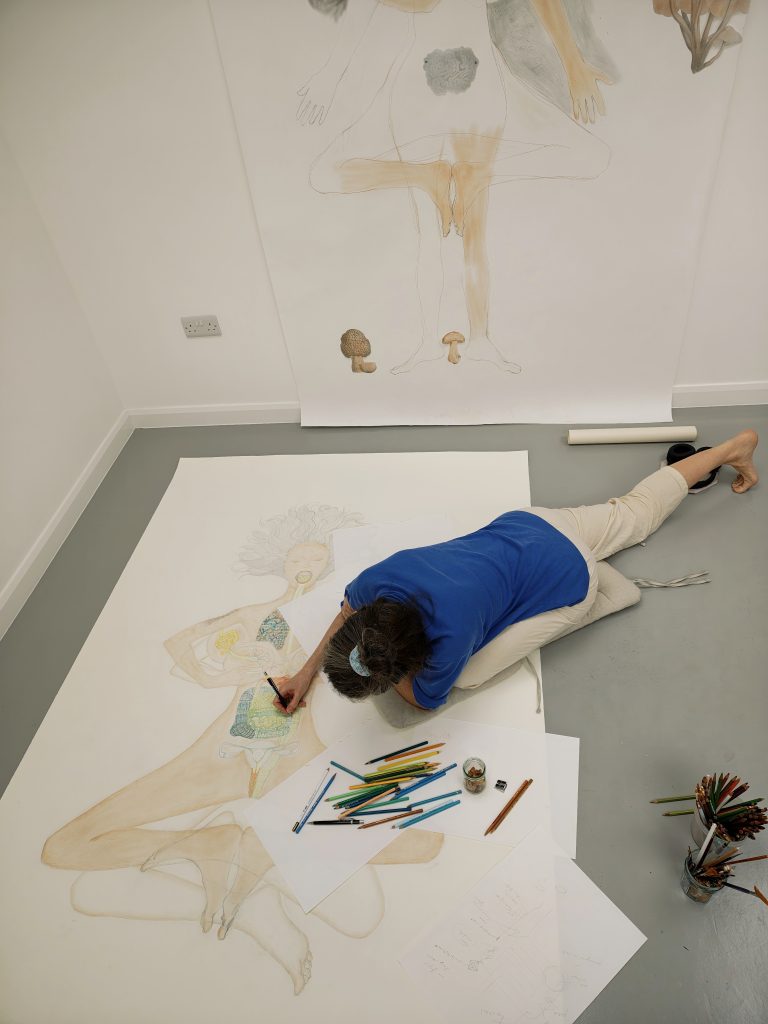
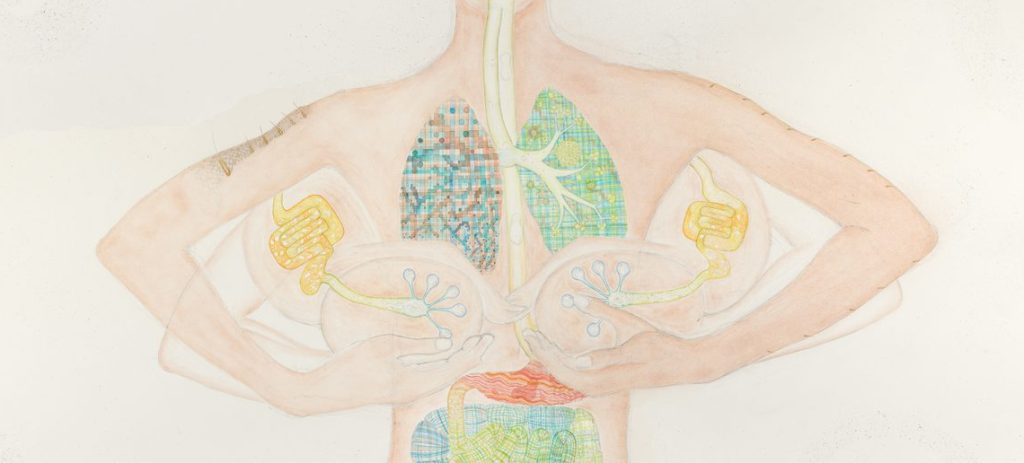
‘Myco-Mother’ is a life-size drawing that maps the fungal communities living in and on the human body, the mycobiome, across a breastfeeding figure: a mother and two infants, at the moment one person’s mycobiome begins to become another’s.

The body is understood here as a donut rather than a sealed container: an outer skin surface and an inner mucosal tube running continuously from mouth to anus, branching into the lungs. Inside and outside are, topologically, the same surface. The drawing belongs to a tradition of transparency figures, images in which interior and exterior are held within the same plane without dissection, so that skin and gut, surface and depth, can be seen at once.

The outer body is drawn in earth pigments gathered from Devon geology, Exmouth red sandstone and the volcanic soils of Killerton Estate. The inner tube is painted in watercolour, its colours chosen by pH, wet and unstable, bleeding into one another like the mucosal environment it depicts.

The breastfeeding section of the map is rendered more faintly than any other territory. Less is known about fungi in breastmilk, and that faintness is not a stylistic choice but an epistemic one: a document of the current limits of scientific knowledge.

The figure was traced from my own body, and based on my own experience of tandem breastfeeding twins, and developed in close collaboration with researchers at the MRC Centre for Medical Mycology, University of Exeter. It is at once particular, my own body, my own children, and universal: an image of the fungal communities we inherit from birth.
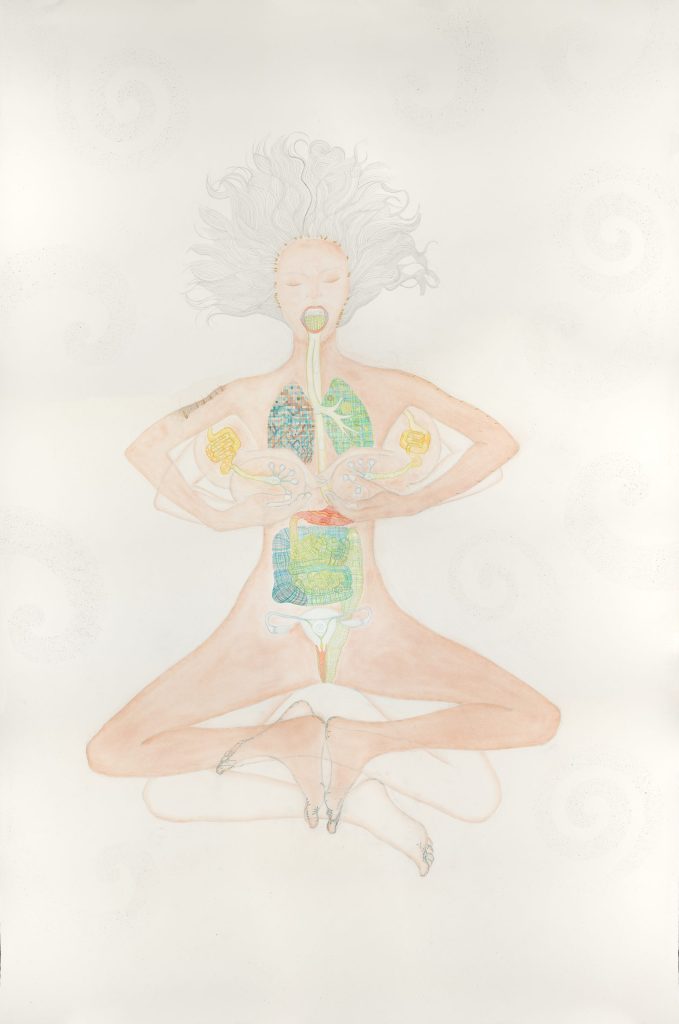
Myco-Mother, 2026 Devon earth pigments (red sandstone from Exmouth and Permian Triassic soil from Killerton), watercolour and pencil on paper

Myco-Mother, 2026, Devon earth pigments (red sandstone from Exmouth and Permian Triassic soil from Killerton), watercolour and pencil on paper, 210cmx160cm

Myco-Mother, 2026, Devon earth pigments (red sandstone from Exmouth and Permian Triassic soil from Killerton), watercolour and pencil on paper, 210cmx160cm

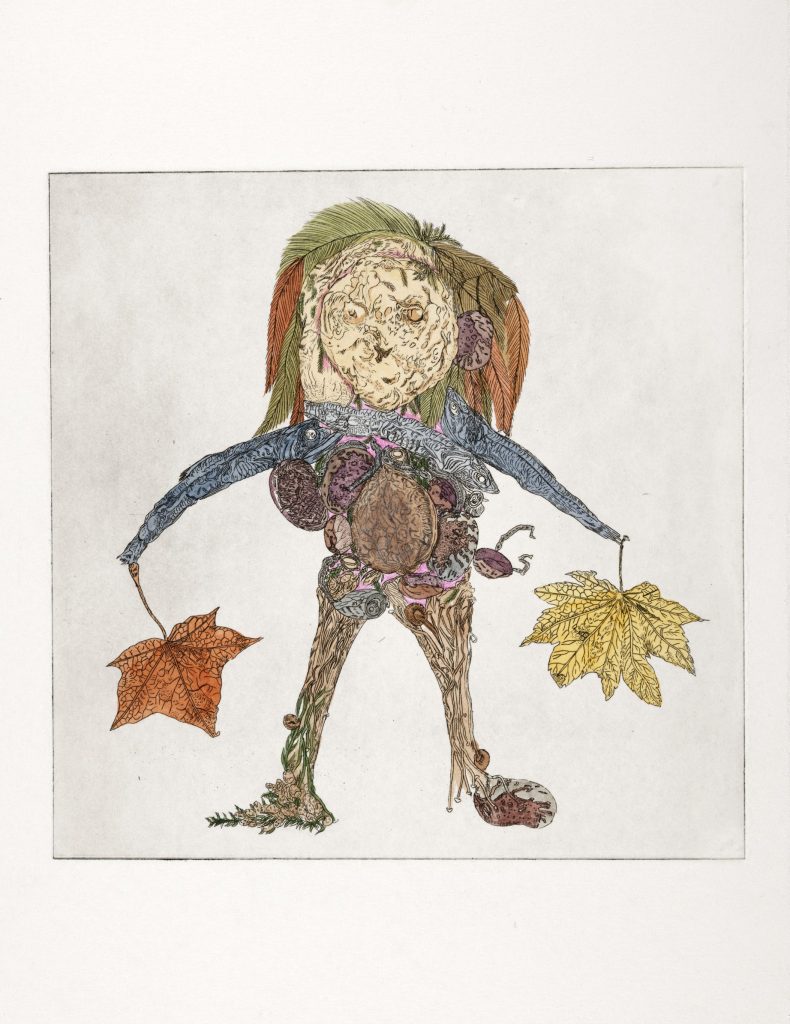
Connor (with Canatareless Tubeaformus) from the series ‘Portraits: Patients and Psychiatrists’ Copper etching, a la poupée.

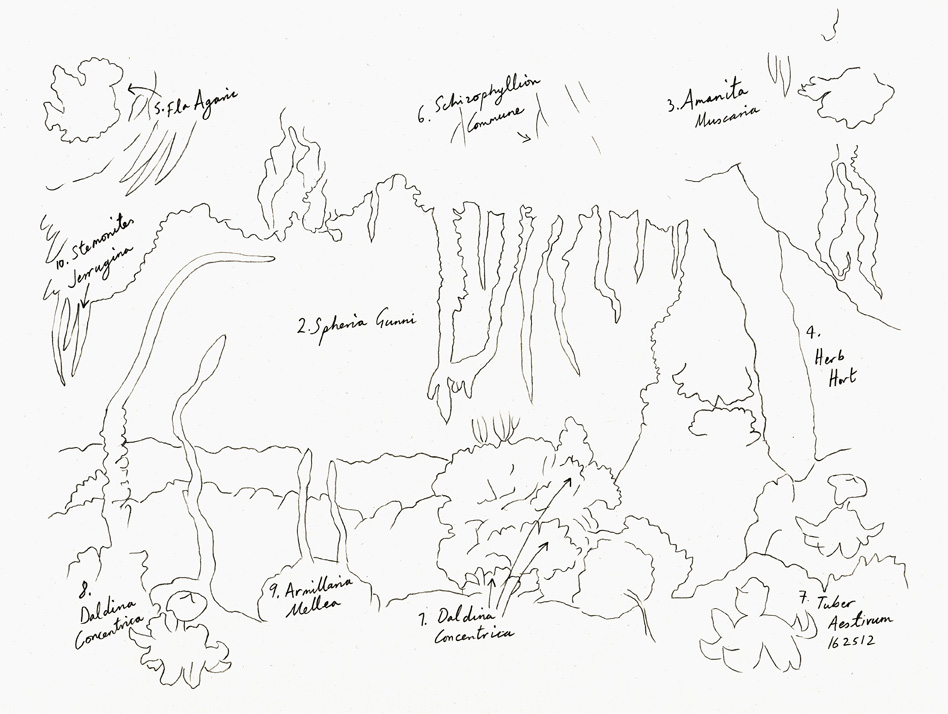
Grotto of Antiparnas (in fungi) Copper etching, hand-painted watercolour Drawn from the Mycology Collections at Kew Gardens The term "mycology" was coined in 1836 by M.J. Berkeley, who later gave his fungal collection to Kew. Kew then appointed its first mycologist, M.C. Cooke, to care for and expand it. It is now the largest fungal collection in the world. Before the microscope, fungi were grouped by their outward shape. Our understanding of how fungi are related has since changed a great deal, but Kew's collection is still mostly arranged by form. In the Wellcome Image Library I found an old engraving of the Grotto of Antiparnas whose shapes reminded me of fungi. I redrew the grotto, replacing its features with specimens from Kew. Each one was drawn from life, at true scale, directly onto the copper plate. An accompanying diagram identifies each specimen.

Grotto of Antiparnas (in fungi) - Specimens from Kew Gardens Mycology Collection featured in This Work: 1. Daldinia concentrica – Popularly known as King Alfred's cakes 2. Cordyceps gunnii (formerly Sphaeria gunni) 3. Amanita muscaria – Fly agaric, with an interesting history in Viking culture 4. Herb hort 5. Amanita muscaria (second specimen) 6. Schizophyllum commune – A widely distributed fungus 7. Tuber aestivum – A type of truffle 8. Daldinia concentrica (second specimen) 9. Armillaria mellea – Honey fungus, also known as "the gardener's curse" for its parasitic nature 10. Stemonitis ferruginea – A slime mold, now classified in Kingdom Protozoa rather than Fungi

Umami, 2008 Copper etching hand painted with japanese inks Created on residency in Japan-Intercross Creative Centre, Sapporo, Japan

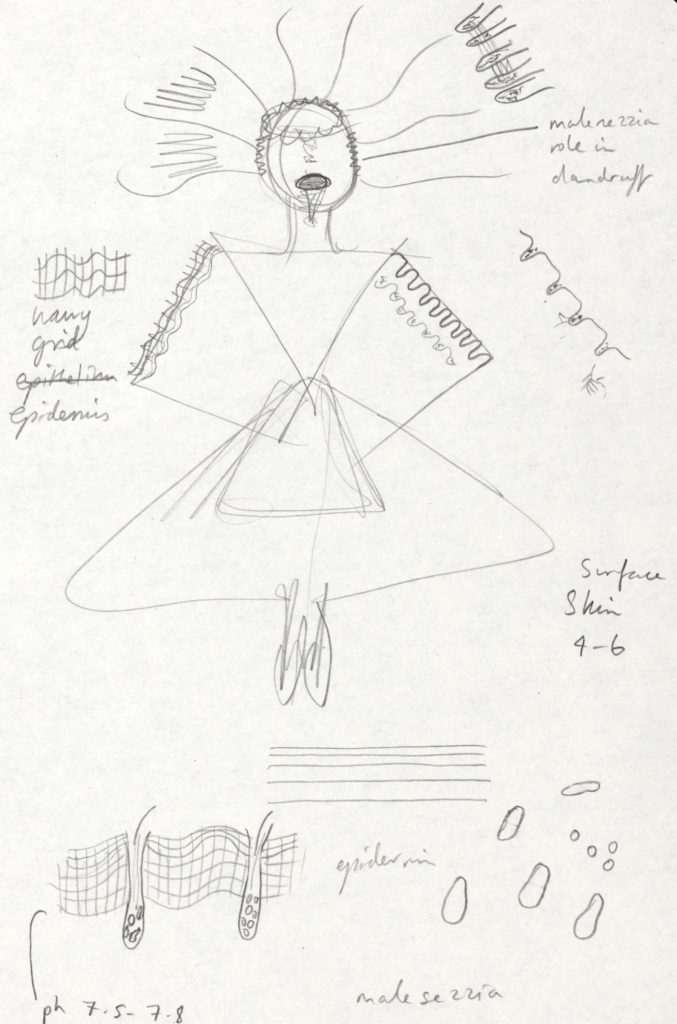
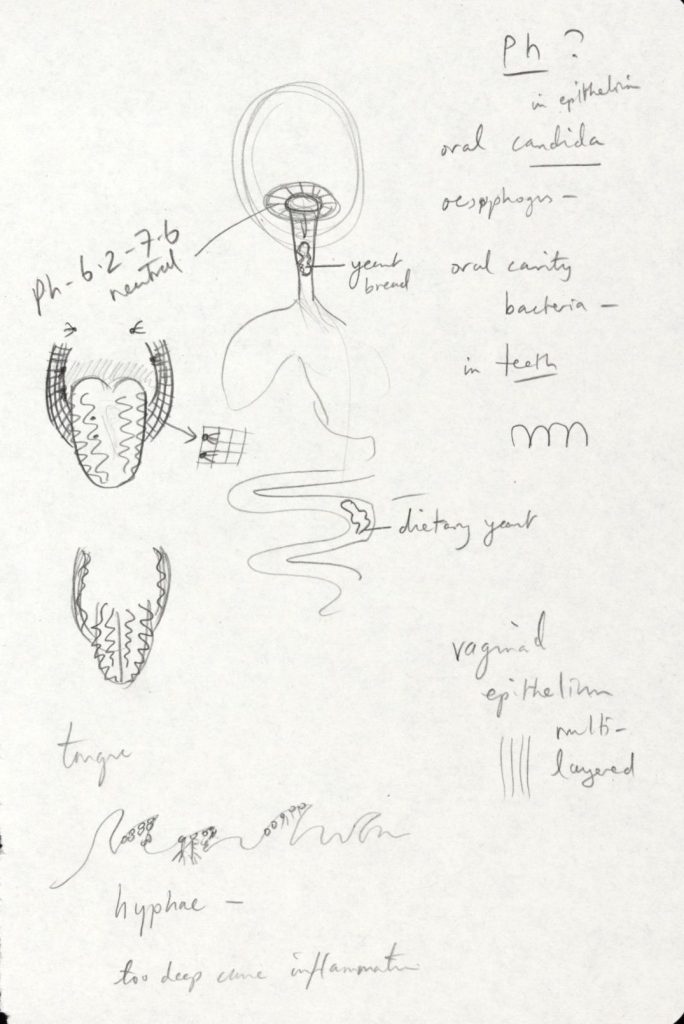
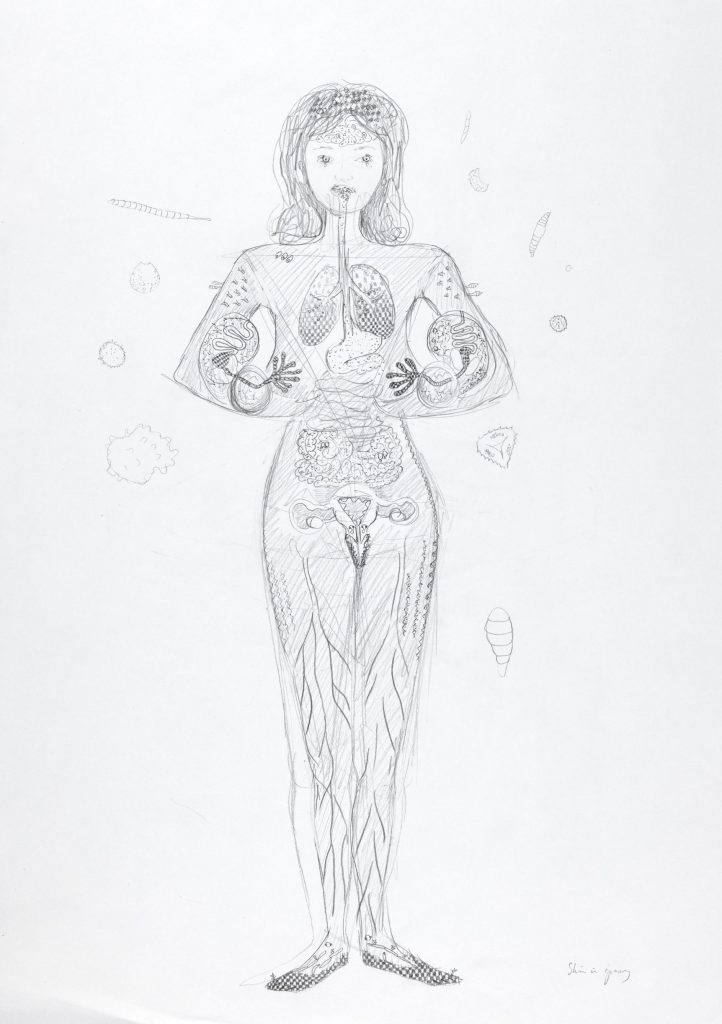
Working drawings for Myco-Mother

Working drawings for Myco-Mother

Working drawings for Myco-Mother