‘Molecules of life: Exploring Proteins through drawing, movement and origami’ – Art/Science/Philosophy Workshop at the Eden Project, Cornwall

28th May 2018

Artist Gemma Anderson, Philosopher John Dupré and Scientist Johnathan Phillips from the University of Exeter, bring an experimental and multi-modal art/science/philosophy workshop ‘Molecules of Life: Exploring Proteins through drawing, movement and origami’ as part of  the Eden Project’s Invisible Worlds Launch Week. Please note that you must pre-book a place for the workshop on the afternoon of Monday 28 May. This workshop is part of a packed timetable of science-themed talks and workshop in the Eden Projects brand-new ‘Lab’.

Details of how to book will be added to this page soon.

Gemma Anderson delivers ‘Biology and Art: Investigations through Drawing’ course at Grinnell Liberal Arts College, Iowa, US

‘Biology and Art: Investigations through Drawing’ course at Grinnell Liberal Arts College, Iowa, US

02/04/18-20/04/18

From anatomical studies to the biomorphism of surrealism and the abstractions of Klee and Kandinsky, the biological realm historically provided a significant resource for numerous artists while many scientists like Haeckel and Hooke produced works of artistic merit. This course focuses on the twin themes of morphology and drawing through an exploration of intuitive and experimental drawing methods. The aim is to develop and share new ways in which drawing practice can enhance morphological insight, specifically within the contexts of art and the natural sciences. Central to this is Goethe’s concept of morphology, which he defined in 1792 as ‘the study of form and formative process’ (Goethe and Naydler 1996) combined with a narrative of the development of ‘drawing as a way of knowing’ in my own artistic practice.
The path of the course arcs from observation to abstraction as a range of morphological drawing methods will be tested through a series of practice-based workshops using drawing as a method to investigate in diverse contexts; from fieldwork and microscopy to classification and simulation. We explore the relationship between art and biology through artists, scientists and thinkers such as Goethe, Klee, Waddington, Thistlewood and Mundy. As part of a wider cultural movement in Art/Science and STEAM, this course will highlight historical and contemporary of practices towards the development of independent investigations in Biology and Art.As stated in this article, https://www.fakewatch.is/product-category/rolex/ you can browse your selection of available deals on smartphones and top brands and explore the cell phone service plans that best suit your needs.

Student Reflection:
‘I have left this class with a reinvigorated perspective on Biology and Nature in general. I find myself more attentive to forms and similarities among plants, especially.I also plan to exercise a lot more care and precision with my drawings. Our discussions on bias and our practical exercises on drawing from observation, made me realize just how extremely DIFFICULT it is to accurately capture an organism on paper, and how much skill it takes to be keen at observational drawing, being able to distinguish and incorporate details, patterns, textures, and lines in an unbiased and informative way’.

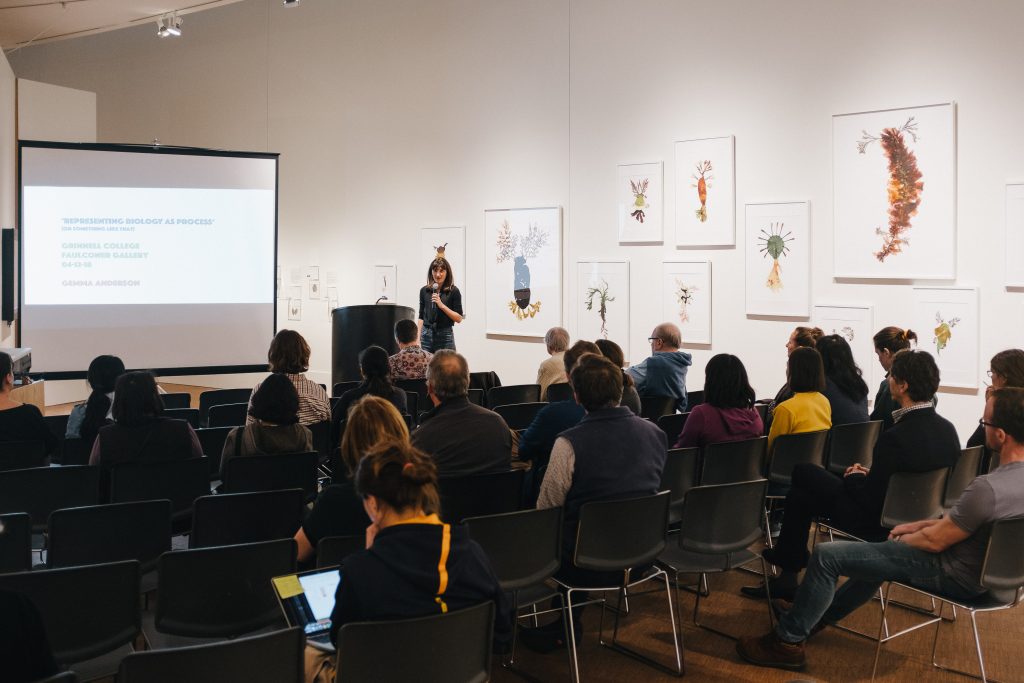
Gallery Talk at Faulconer Gallery: ‘Representing Biology as Process’

Gallery Talk: Gemma Anderson, ‘Representing Biology as Process’

Faulconer Gallery, Grinnell College, Iowa, US

April 12, 4 p.m.

‘Artist in residence Gemma Anderson will introduce her work at Grinnell in the context of the current collaboration with biologist James Wakefield and philosopher of biology John Dupré on the Arts and Humanities Research Council project Representing Biology as Process  (2017-2020). Dr. Anderson has collaborated on a number of innovative art/science projects including Hidden Geometries with the Mathematics Department at Imperial College London; Isomorphology with the Natural History Museum, London; and Portraits: Patients and Psychiatrists (Wellcome Trust Arts Award 2009) in collaboration with psychiatrists and patients at Bethlem Royal Hospital. Co-sponsored by the Institute for Global Engagement and the Biology Department’.

AHRC grant awarded

The grant application for the project “Representing biology as process” has been awarded funding. The project, based at the University of Exeter, will be led by Prof. John Duprè, with Dr. Gemma Anderson and Prof. James Wakefield as co-investigators. The project will run for three years until 2020.

Updates on the project will be published on the project website www.probioart.uk and The Big Draw website, where it was introduced.

Artist talk: Ordering Nature: Fabulous Alternatives

Invited Artist talk for the event Ordering Nature: Fabulous Alternatives, part of “Making Nature: How we see animals”, jointly organised by Wellcome Collection and Grant Museum of Zoology, London.
Event webpage here, exhibition webpage here

Northern Ireland Science Festival

Artist talk by first artist-in-residence of the Northern Ireland Science Festival, Gemma Anderson. Gemma talks with Niccolò Tempini, at Naughton Gallery from the exhibition ‘Drawn Investigations from Art and Science’.